

.png)


The OECD's latest tourism report puts Colombia's approach to peace through tourism firmly on the international policy agenda. Behind that recognition is more than USD 4 million in investment, hundreds of tourism businesses and years of work in communities affected by conflict.
In Colombia, 774 entrepreneurs now hold authorisation to use a label called Colombia, Destinations of Peace. Many of the people behind those businesses are victims of the armed conflict, former combatants, or farmers who have replaced illicit crops with something they can build a future on.
On 1 July, the OECD published Tourism Trends and Policies 2026, and in Colombia's country profile it identifies facilitating a culture of peace through tourism as the leading policy priority, supported by figures.
This matters for every destination trying to make the case that tourism can do more than generate arrivals.
What the OECD documented
The OECD report is published every two years and provides an important international reference point for tourism trends, policies and reforms. Colombia's inclusion highlights an approach that has often been treated as aspirational in mainstream tourism policy.
The figures behind it are specific. More than USD 4 million have been invested. Over 480 tourism enterprises and productive units have entered tourism supply chains. Some 903 peace related tourism businesses have been catalogued and 100 tourism experiences strengthened. Four Peace and Memory Tourism Corridors have been created, alongside a national network of destinations of peace.
The wider context shows the scale of the sector these businesses are joining. Colombia welcomed a record 7.1 million international visitors in 2024. Tourism now contributes 2.2 per cent of national gross value added, supports close to 900,000 jobs and accounts for almost half of the country's service exports.
None of this was quick. Peace tourism has been part of Colombian policy since 2014, and the Destinations of Peace seal was launched at ITB Berlin in 2023. Twelve years of patient institutional work sit behind one paragraph in an international report.
Being honest about what tourism can do
It is important to be clear about the limits, because credibility depends on it.
Tourism does not end conflict. It cannot replace security, justice, land policy or public investment. Where those foundations are missing, tourism arrives late and leaves quickly. Communities know this better than anyone, and they are rightly sceptical of visitors bearing promises.
What tourism can do, when communities lead it, is give recovery an economic footing in places where the alternatives are few. It creates income that does not depend on illicit crops. It gives young people a reason to be proud of their heritage and build their future where they already live. It gives small businesses, municipalities and residents something practical to organise around together. And over time it changes how a territory is described, first by the people who visit it and then by the people who live there.
These are long term outcomes. They are also the foundations that make everything else possible.
What this looks like in practice
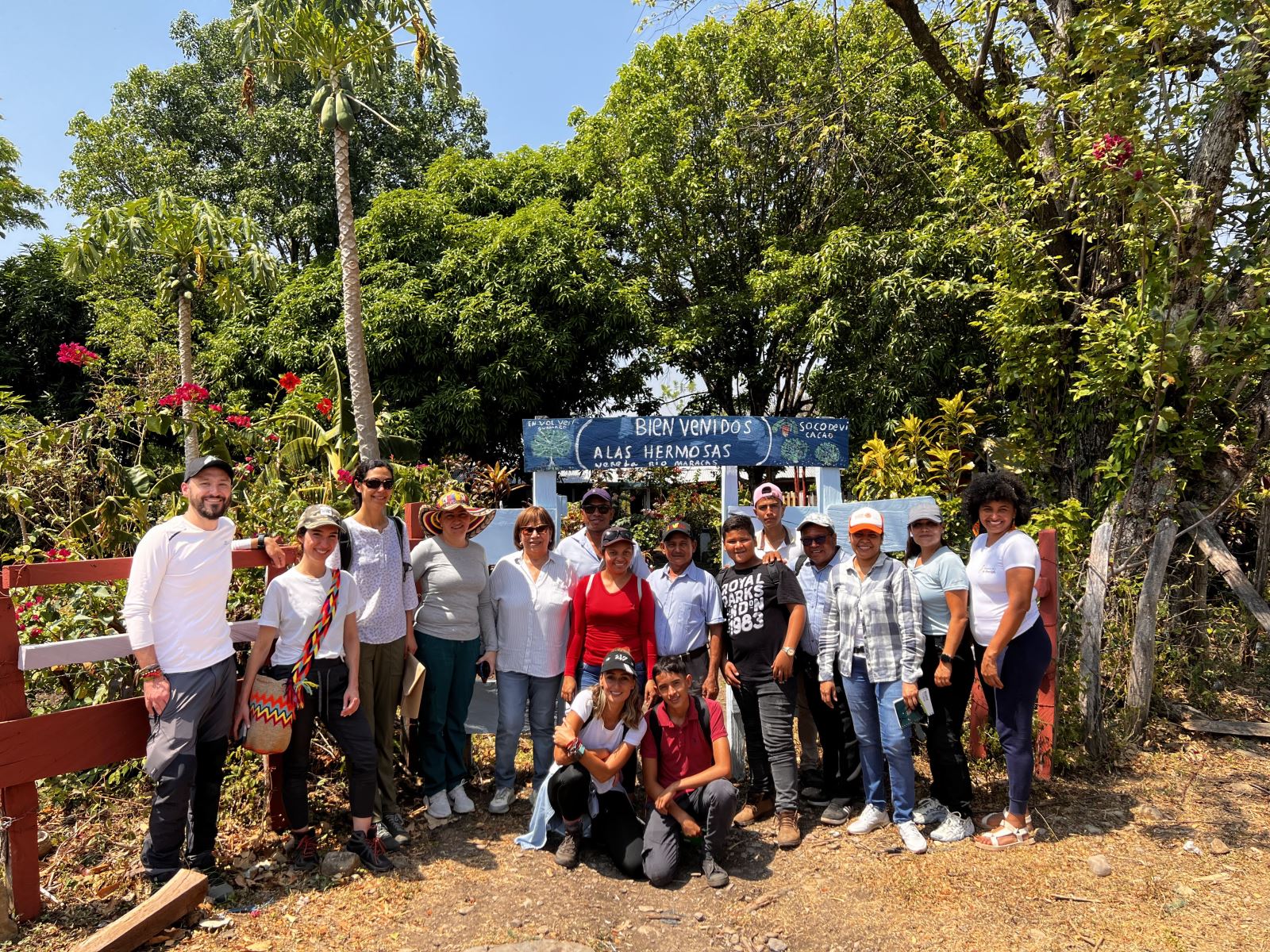
We have been working on this in Colombia since 2019 through EcoTourism Routes for Forests and Peace, led by Grupo E3 consultoresalongside the Royal Botanic Gardens Kew and Think Galapagos, with funding from UK PACT. The project supports rural communities in two regions of exceptional biodiversity that were among the areas worst affected by the conflict.
One is Serranía de las Quinchas in Boyacá, at the centre of Colombia's emerald mining country, where communities lived through decades of the green wars and had coca production imposed on them. The other lies in the Serranía del Perijá on the Venezuelan border, in the villages of La Victoria and Estados Unidos, Cesar. Both sit beside forest that is globally significant and locally under pressure, for the simple reason that clearing the trees is paid better than protecting them.
The premise of the work was that this equation can be changed. If visitors will pay to walk into a standing forest with the people who know it best, the forest becomes an asset rather than an obstacle, and conservation stops being something asked of communities and becomes something that pays them.
That only holds if the communities lead it. Routes were developed with residents rather than designed elsewhere and handed over. Local knowledge and stewardship of the forest formed the substance of the visitor experience rather than the decoration around it. And success was measured by whether local businesses gained customers, whether collaboration between the communities held, and whether the forest became worth more standing than cleared.
.jpg)
Why this reaches beyond Colombia
Many destinations already have places, stories and experiences that could support a peace tourism approach, but they are not yet connected through a clear strategy or framework. These might include territories recovering from conflict, sites of memory, museums documenting reconstruction, cross border parks, Indigenous cultural landscapes and pilgrimage routes.
Colombia did not invent these assets. It organised them, backed them institutionally, funded them and gave them a recognisable identity. That is the part other destinations can learn from, because a governance model transfers far more easily than a product does.
There is a wider point here too, made well by Imtiaz Muqbil of Travel Impact Newswire in his analysis of the OECD report. Tourism is among the first sectors to suffer when peace breaks down, yet the industry has often treated conflict and instability as political questions lying outside its mandate. The working assumption has been that tourism responds to peace without helping to build it. Colombia offers a practical answer to that, and the OECD has now put it on the record.
Measuring what actually matters
If tourism is to be treated as a development tool, it should be assessed like one.
Visitor numbers tell you about demand. They tell you very little about whether local businesses are capturing value, whether young people are staying, whether natural and cultural assets are in better condition than before, or whether communities have more say over their own future than they did five years ago. Colombia's figures are powerful precisely because they count enterprises, entrepreneurs and corridors rather than arrivals alone.
For destinations elsewhere, the practical question is a simple one. Can you say what your tourism strategy is meant to achieve beyond growth, and are you measuring it?
At Acorn Tourism Consulting and through our work at ALAS in Latin America led by our Peace Tourism specialist Nicole Layolle, that is where we start with every destination we support. If you are developing a strategy where tourism needs to deliver more than visitor numbers, whether that means recovery, resilience, conservation or community opportunity, we would welcome the conversation.
Read the OECD Tourism Trends and Policies 2026 report here. Further coverage of the Colombia case is available from eTurboNews.
Related

We worked with three very different rural communities, all with exceptional biodiversity and all of which had been severely affected by the conflict in Colombia. Together with E3 Group in Colombia and RHS Kew Gardens, we developed tourist routes that promote forest protection and peacebuilding through community-based ecotourism.
Comments
Nobody has commented on this post yet, why not send us your thoughts and be the first?

