

.png)


A lodge owner in the Amazon, a dive operator in the Caribbean or a destination management company in the Andes may never have needed to read EU sustainability legislation. Yet, over the past two years, a growing number of destinations and small operators outside Europe have received emails from European tour operators or online travel agencies asking for sustainability data, a carbon estimate or evidence to support an environmental claim.
That request is not a mistake. It is one way in which the EU's sustainability agenda is influencing tourism supply chains beyond Europe: through the buyers and partners that work with you.
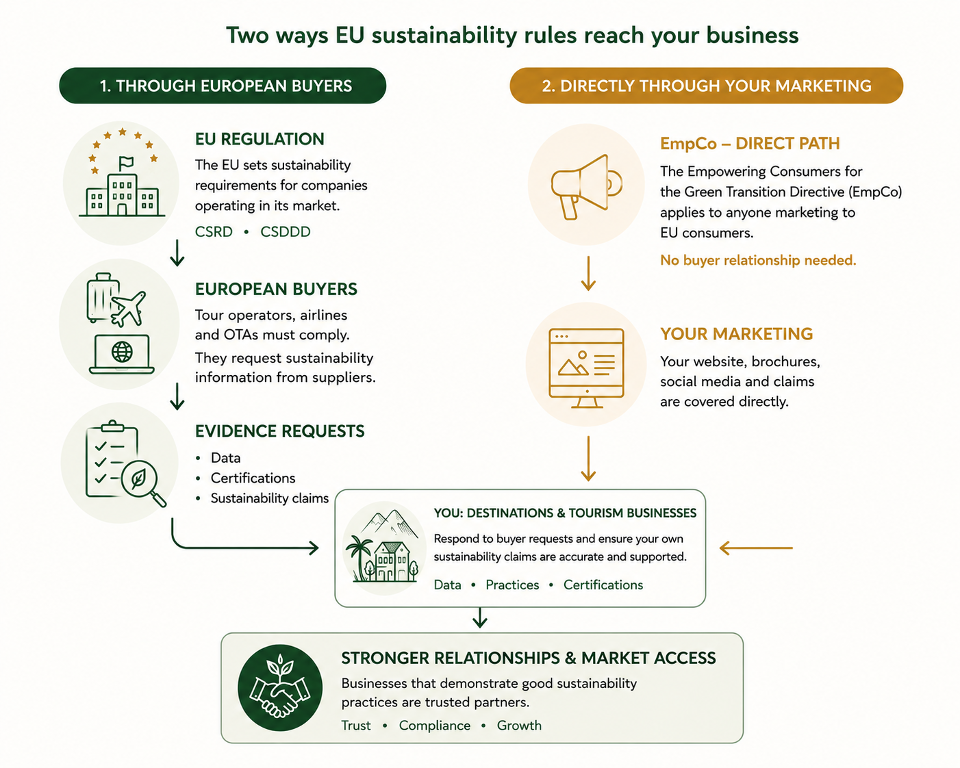
For many destinations, the practical effect is felt in two ways: through European buyers requesting sustainability information and through consumer-protection rules that may affect marketing directed at EU travellers.
Understanding why this is happening, and how to respond proportionately, matters because the EU framework has changed significantly during 2025 and 2026.
Why are European buyers requesting sustainability information?
The EU sustainability reporting and due-diligence rules mainly apply to companies within their defined scope, rather than directly to an independent hotel in Cusco or a tour company in Cape Town. However, large tour operators, airlines and online travel agencies may need information about impacts and risks within their value chains, which may include your business. The Corporate Sustainability Reporting Directive (CSRD) requires companies in scope to report specified sustainability information. The Corporate Sustainability Due Diligence Directive (CSDDD or CS3D) requires companies in scope to identify and address certain adverse human-rights and environmental impacts. When a European buyer contracts your accommodation, excursion or destination service, your business may form part of the information it uses to meet these obligations and manage its own sustainability risks.
What changed under the EU Omnibus I package?
The Omnibus I reforms substantially narrowed the scope of both directives. Under the final EU agreement approved in February 2026, the revised CSRD threshold covers companies with more than 1,000 employees and more than EUR450 million in net annual turnover. The revised CSDDD threshold is higher: more than 5,000 employees and more than EUR1.5 billion in net annual turnover. The timetable has also been extended. As a result, many medium-sized European tourism businesses are no longer directly within scope, although national implementation and individual company circumstances still need to be checked.
That sounds like good news for a destination worried about paperwork, and in one sense it is. Fewer companies now face a legal duty to chase you for data. However, the businesses that remain in scope are exactly the ones with the biggest buying power in international tourism: the major tour operator groups, the large airlines, the biggest booking platforms. They still need the information, they are still building it into procurement decisions, and many smaller operators continue to ask for it because their own bank, insurer or investor expects it. The volume and detail of requests may change, but evidence-based sustainability information is likely to remain relevant to market access and procurement.
What does the Empowering Consumers Directive (EmpCo) mean for destinations?
A separate EU measure addresses environmental claims made to consumers, commonly referred to as EmpCo, the Empowering Consumers for the Green Transition Directive (Directive (EU) 2024/825) which must be applied by EU Member States from 27 September 2026. It strengthens the rules against generic environmental claims, such as 'green' or 'environmentally friendly', where recognised excellent environmental performance cannot be demonstrated. It also restricts sustainability labels that are not based on a certification scheme that is third-party audited or established by a public authority, and places tighter conditions on claims about future environmental performance and greenhouse-gas impacts. The precise legal position for a destination or operator outside the EU will depend on how and where its marketing is directed, but European commercial partners will expect claims used in their sales channels to be specific, accurate and supported by credible evidence.
What should destinations and tourism businesses do now?
Start with the information you already hold. Energy and water use, waste management, employment practices, purchasing and community impacts commonly appear in buyer questionnaires. Establish a consistent baseline, record the source and reporting period for each figure, and be clear where data is estimated. Credible third-party certification can strengthen evidence, but it does not automatically substantiate every marketing claim: check the scope of the standard and describe precisely what has been assessed. Before publishing terms such as "sustainable", "responsible", "low carbon" or "carbon neutral", ask: what exactly does this mean, what evidence supports it and can a reader access that evidence? Where the answer is unclear, use more specific language or remove the claim.
Smaller businesses also have a practical reference point. In July 2025, the European Commission adopted a recommendation on the voluntary sustainability reporting standard for small and medium-sized enterprises (VSME). It is intended to provide a proportionate, standardised way for SMEs to share sustainability information with larger companies and financial institutions. It will not replace every buyer questionnaire, but it can help a business organise its evidence and challenge requests that are unnecessarily complex or disproportionate.
Turning compliance pressure into a market opportunity
These changes do not automatically make every destination outside Europe directly subject to EU sustainability law. They do, however, shape the expectations of European buyers and consumers. Destinations and operators that can respond efficiently, honestly and with proportionate evidence are easier to contract, promote and trust. When a buyer is choosing between otherwise comparable suppliers, good sustainability data and well-founded claims can become a commercial advantage.
Acorn Tourism Consulting helps destinations and tourism businesses prepare for changing market expectations through practical sustainability assessments, evidence reviews and market-readiness support. To discuss what these developments may mean for your destination or business, contact Nicole at nicole@acorntourism.co.uk
Related
Comments
Nobody has commented on this post yet, why not send us your thoughts and be the first?

